
Read McDuffie County Property Tax Records
McDuffie County splits the work in two. The Assessor determines fair market value and assessed value. It also grants exemptions and maintains the tax digest. The Tax Commissioner handles the billing side. This means the amount due, payments, delinquency, tax FIFAs, payoffs, and tax-sale details. A value on the assessor card is only an input.
| Field | What It Shows | Where |
|---|---|---|
| Fair market value | Assessor's estimate before assessment ratio | Tax Assessor |
| Assessed value | Value used in the tax calculation | Tax Assessor |
| Exemptions | Approved relief that can reduce taxable value | Tax Assessor |
| Bill and payment status | Tax charged, paid, or still due | Tax Commissioner |
| FIFA or sale status | Delinquency enforcement record | Tax Commissioner and Clerk |
Ordinary assessments run 40 percent of fair market value. Millage and valid exemptions then shape the tax. Neither figure is an appraisal or a prediction of what a McDuffie County property would sell for.
Find a McDuffie Property Tax Bill
Use the official McDuffiePay portal to handle real, personal, mobile-home, and timber taxes online. Every McDuffie County tax bill there hangs on the full map-and-parcel value, so begin your property search with that same number. Questions about a payoff or a delinquency? Call the Tax Commissioner at 706-595-2132.
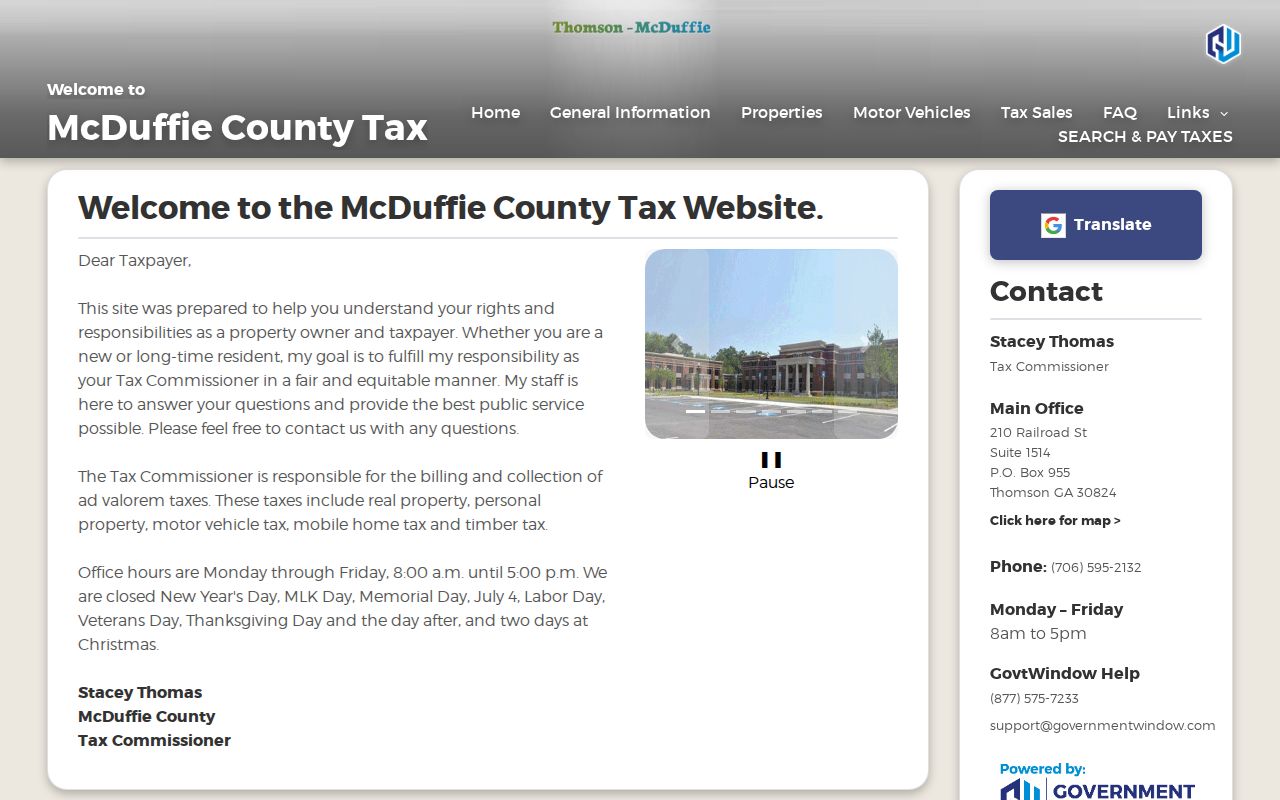
The McDuffiePay landing page confirms the official online route for McDuffie County tax bills. Payoff, redemption, and certified-status questions still belong with the Tax Commissioner.
- Identify the parcel on the county Search Records page and copy its full key.
- Open McDuffiePay and locate the corresponding bill.
- Compare the bill year with the assessor's certified-roll year and exemptions.
- Ask the Tax Commissioner about payment history, payoff, FIFA, or redemption when status is unclear.
- Check the Clerk's lien index for a recorded FIFA and any later release.
- Assessed value
- The value to which tax calculations are applied.
- Millage
- A levy rate used with taxable assessed value.
- Homestead exemption
- Approved relief connected to a qualifying primary home.
- Tax FIFA
- A recorded execution for unpaid property tax.
McDuffie's Last-Certified-Roll Warning
The McDuffie County property-search page states that assessment data comes from the most current published or last certified tax roll, and that other details can change. So the data year matters. A new deed can post before the card changes. The county publishes no exact refresh schedule. Whenever ownership affects an exemption or a bill, compare the assessor's owner of record with the latest recorded deed. Ask the office whether a later conveyance is on file but not yet in the displayed roll. Never treat the card as instant title.
McDuffie Exemptions Need Separate Labels
McDuffie County's published examples include a regular homestead at $4,000, an income-qualified age-62 amount at $15,000, and an age-65 school assessed-value example at $30,000. These are separate programs. Merging them into one promised break is a mistake.
Eligibility, filing dates, income rules, disability status, and school-tax treatment all differ. Confirm the current application and evidence with the assessor. An exemption flag can support a tax analysis, but it proves neither residence nor title.
McDuffie Land Use Changes the Value Math
Ordinary real property and business equipment are assessed at 40 percent of fair market value. Preferential agricultural land gets 30 percent. Conservation, environmentally sensitive, and residential transitional categories run through covenants. Standing timber is taxed at 100 percent of fair market value, at sale or harvest.
| Category | Published treatment | Record to confirm |
|---|---|---|
| Ordinary real property | 40% assessment basis | Parcel assessment |
| Preferential agricultural | 30% described basis | Application and covenant |
| Conservation or sensitive land | Covenant-based treatment | Assessor file |
| Standing timber | 100% at sale or harvest | Timber tax record |
Zoning, use, deed covenants, and improvements all shape value. Compare parcels within the same property class before treating one sale as proof.
November Timing in McDuffie Tax Records
McDuffie County mails real and personal bills in September. Payment is due November 15. Partial payments are accepted. Interest runs one percent per month after the due date, with a ten percent penalty after 90 days. The FAQ also describes interest after December 20, wording worth confirming for any specific bill.
The official property-tax page posts current instructions.
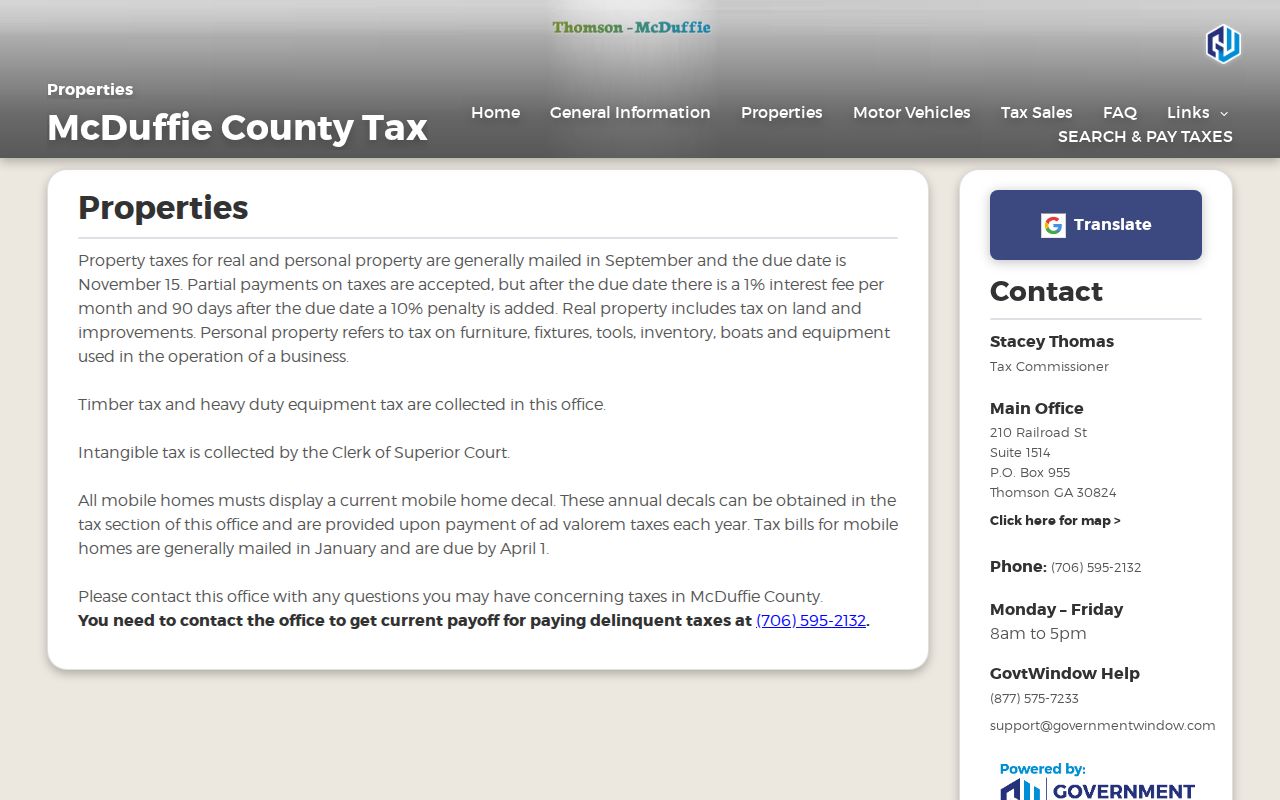
That McDuffiePay property page is where year-specific timing lives. A missing bill does not mean no tax is due, so ask the Tax Commissioner for a dated payoff.
A McDuffie Tax-Sale Row Is a Research Bridge
The official August 2025 list is a historical sample, not a 2026 sale calendar. Each row carries map and parcel, defendant in Fi-Fa, and current record holder. Property address and amount follow. Tax years, deed book, and legal description round out the row. That compact schema links tax records to deeds and plats.
One row tied Carver Street in Kingswood Subdivision to Deed Book 107 page 684. It also listed Plat Book O page 102. Another connected Liberty Street in Kingswood Park to Deed Book 674 page 563. It also listed Plat Book P page 83. Neither row proves a completed sale. Search later deeds, releases, and the present roll. Do that before concluding a listed sale happened or changed title.
Tax FIFAs Move Into McDuffie Clerk Records
Unpaid McDuffie County tax older than 90 days becomes a tax FIFA recorded with the Clerk, according to the Tax Commissioner's FAQ. The GSCCCA lien form narrows to McDuffie County and to instrument types like FIFA, lien, release, or cancellation. Search both roles. Debtor and claimant views can surface different hits. Payment and a recorded release are separate facts. For a current answer, request payoff and redemption status from the Tax Commissioner and confirm the Clerk's filing history. A tax-sale notice alone never proves a completed transfer.
Use the McDuffie Counter When Online Status Is Thin
The assessor's office answers parcel questions on weekdays from 8 a.m. to 5 p.m. Ask for the parcel card, certified-roll details, assessment history, exemption status, and roll date. Request these as separate items. Request the owner of record, mailing address, situs, and legal description one by one. Billing questions go to the Tax Commissioner. That office handles bills, payoffs, payment history, delinquency, tax fi.fa., and tax-sale status.
A specific record may not be posted online. In that case, a Georgia Open Records Act request works well. Include the parcel number, tax year, and record type. The Attorney General's guidance treats the first 15 minutes of search time as free. Reasonable search, redaction, and copy costs apply after that. Narrow requests cost less and cause less confusion.
The county's 2026 tax-office materials show shifting homestead relief details. The 2025 millage documents are still posted. Check any year-specific notice before relying on it. Office roles and the assessment framework hold steadier. They outlast a dated credit, due-date notice, or sale list.
McDuffie Property Tax Records Need a Date Stamp
Write down the tax year, the date you viewed it, and the source of each amount. Note the source of each amount. Did it come from the assessor, a bill portal, an office confirmation, or a dated sale notice? Partial payments, later releases, redemption, and annual exemptions can all change a status. A dated note keeps a historical list separate from a present bill. It also stops a published example from turning into a current claim.
Reconcile McDuffie Assessment and Billing Years
An assessment notice, certified roll, and tax bill can each carry different dates. So can a payment entry and a tax-sale list. Note each year before comparing any amounts. A value change may come from reassessment, new construction, class, covenant, or exemption. Corrected parcel facts can do it too. The bill adds millage and taxable value into the math.
A parcel with a Thomson or Dearing mailing address still needs its taxing jurisdiction confirmed. Postal city means little here. The assessor and tax offices stay countywide sources. Thomson and Dearing add their own zoning or permit context. That context can explain use and improvement records. But it never changes who keeps the deed or the county tax roll.
Keep timber apart from ordinary real estate and business equipment. The assessor values standing timber at sale or harvest. That treatment uses its own 100 percent fair-market basis. Mixing that figure with a land assessment invites false comparisons. Ask the office to name the category, covenant, exemption, and tax year on display.
Build a sale or appeal file with the assessor notice, parcel card, bill, payment proof, photographs, and measurements. Add comparable sales or assessments, plus any covenant or exemption papers. Label every amount clearly. Call it fair market, assessed, taxable, billed, paid, or due. Those words are not interchangeable.
Current status can take two calls. The Assessor explains property class, value year, exemption, and the digest entry. The Tax Commissioner confirms the bill, partial payment, interest, penalty, payoff, fi.fa., or redemption. A release should sometimes have been recorded. The Clerk can verify its book and page. The Clerk can also confirm the certification.
Never assume an assessment appeal pauses every collection step. Ask each office directly how a filed appeal affects that year's billing and payment duties. Keep the dated notice and any written response. Tax guidance can shift from one cycle to the next.
Contest a McDuffie County Assessment
The assessor's annual notice starts a 45-day appeal window. An owner can challenge value, taxability, uniformity, or an exemption denial. Routes include the Board of Equalization, arbitration in qualifying cases, and later Superior Court review. Save the notice envelope and file by the stated deadline.
Strong evidence is parcel-specific. Bring the notice, plus photos showing condition. Add correct acreage and improvements, arm's-length sales, comparable assessments, covenants, and any wrong property class. The Clerk runs Board of Equalization functions, while the Assessor supplies the valuation record.
Appeal window. File within 45 days of the assessment notice and use the deadline printed on that year's notice.